Why Regular Nail Trims Are Important for Your Dog’s Health
Listen for a moment the next time your dog walks across the kitchen floor. Do you hear a tap, tap, tap? That sound is one of the most common things we notice when a new dog comes through our doors, and it’s more than just noise. It’s a sign that your dog’s nails are touching the ground with every step, and that affects far more than your hardwood floors.
After two decades of caring for thousands of dogs here in Mobile, we can tell you that nail care is one of the most overlooked parts of a dog’s health routine. It’s also one of the simplest to get right.
How Overgrown Nails Affect Walking, Posture, and Comfort
A dog’s nails aren’t like our fingernails. They’re connected to the bones of the toes, which means every bit of extra length changes how the foot meets the ground.
When nails get too long, they hit the floor before the paw pad does. That pushes the toes upward and sideways, and the foot can no longer land flat and balanced.
To compensate, your dog shifts their weight backward onto their hind legs and changes the way they carry themselves. Over weeks and months, that altered posture puts extra strain on the wrists, elbows, hips, and spine.
Think of it like walking all day in shoes that are a size too small. You’d adjust your stride to avoid the discomfort, and eventually your knees and back would start complaining too. Dogs do exactly the same thing, but they can’t tell us their feet hurt. They simply walk less, play less, hesitate on stairs, or become a little grumpier than usual.
Long nails also reduce traction. The paw pads are designed to grip the ground, and when nails lift the pads off the floor, dogs slip more easily, especially on tile, laminate, and hardwood.
How Often Do Most Dogs Need Their Nails Trimmed?
For most dogs, every three to four weeks is a good rhythm. Some dogs need attention every two weeks, while others who spend a lot of time running on concrete or pavement naturally wear their nails down and may go a bit longer.
Frequency matters for a reason many owners don’t know about. Inside each nail is the quick, a living blood vessel and nerve. When nails are allowed to grow long, the quick grows longer with them. That means you can’t safely cut an overgrown nail back to a healthy length all at once. Regular, frequent trims encourage the quick to recede over time, so the nail can gradually return to a comfortable length.
In other words, consistency is what keeps nails short. Occasional “big trims” can’t do the same job.
Signs Your Dog’s Nails Are Too Long
You don’t need to be a groomer to spot the warning signs. Watch for:
- Clicking or tapping on hard floors when your dog walks.
- Nails touching the ground when your dog is standing still. A healthy nail should sit just above the floor.
- Toes that splay or twist to the side instead of sitting neatly together.
- Slipping on smooth floors or reluctance to walk on them.
- Changes in gait, such as a shorter stride, a hunched stance, or favoring one leg.
- Nails that curl or start to grow in a circle, especially the dewclaws on the inside of the leg, which never touch the ground and don’t wear down naturally.
- Licking or chewing at the paws, which can signal discomfort.
If your dog is showing more than one of these, it’s time for a trim.
Dog Nail Trimming vs. Dog Nail Grinding
Both methods are effective, and many dogs do best with a combination of the two. Here’s how they compare.
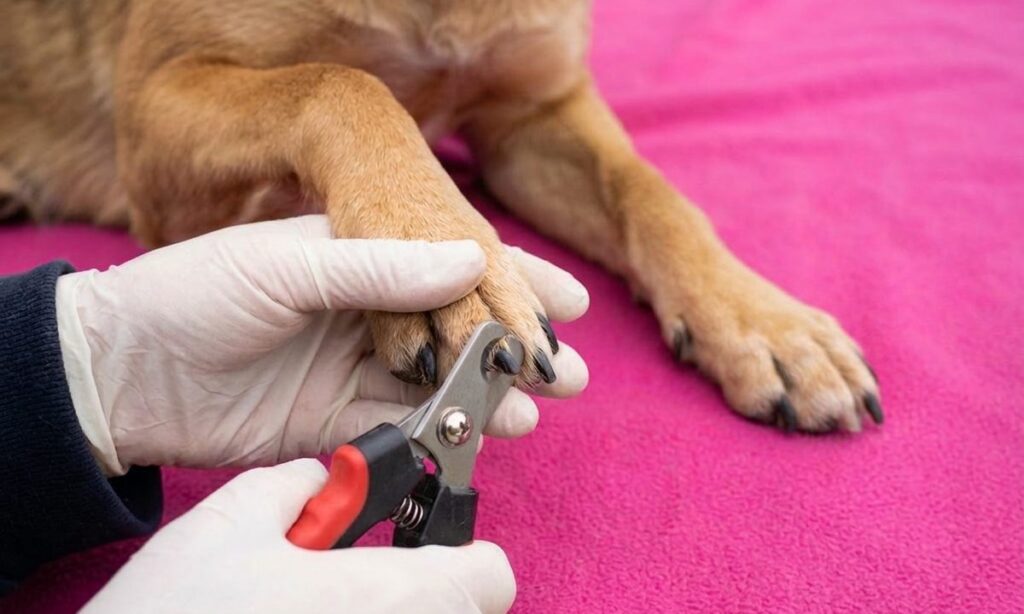
Uses clippers to remove length quickly with a clean cut. It’s fast, quiet, and efficient, which makes it a great choice for dogs who don’t like long handling sessions. The trade-off is that clipping can leave sharp or slightly rough edges, and it takes a practiced eye to avoid the quick, particularly on dark nails where the quick isn’t visible.
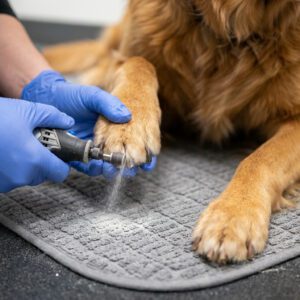
Uses a rotary tool to file the nail down gradually. Because it removes small amounts at a time, it gives the groomer excellent control, which is especially helpful for black nails and for gently encouraging the quick to recede. Grinding also leaves a smooth, rounded edge that’s kinder to your furniture, your floors, and your legs. The trade-off is that some dogs need time to get used to the sound and vibration.
At Walks and Wags, we often clip to remove the bulk of the length and then finish with the grinder to smooth and shape. For dogs who are sensitive to one tool or the other, we adjust the approach to fit them.
Why Senior Dogs Are Especially Affected
Our senior pups hold a special place in our hearts, and nail care is one of the most meaningful things we can do for them.
Older dogs tend to be less active, which means their nails wear down less naturally and grow long faster than you might expect. At the same time, many seniors are already managing stiff joints or reduced muscle strength. When overgrown nails throw off their balance and posture, the effect is magnified. A small slip on a slick floor can mean a big setback for an aging dog.
Seniors can also lose some of their sense of where their feet are, so good traction becomes even more important. Keeping their nails short helps their paw pads grip the ground, gives them more confidence on their feet, and supports their independence and quality of life.
If you have a senior dog, we recommend making nail care a regular, non-negotiable part of their routine, ideally alongside gentle, low-impact exercise like swimming.
What Happens When Nail Maintenance Is Delayed
When nails go too long without care, small problems can quickly become bigger ones:
- The quick grows longer, making it harder to return the nail to a healthy length and requiring several gradual trims to get there.
- Nails can split, crack, or break, which is painful and can bleed.
- Dewclaws can curl into the paw or leg, causing pain, wounds, and possible infection. When this happens, a visit to your veterinarian is the right next step.
- Posture and joint strain build up over time, affecting how comfortably your dog moves.
- Nail care becomes stressful. A dog whose feet already hurt is understandably less willing to have them handled, and that can make future trims harder for everyone.
The good news is that all of this is preventable with a steady routine.
At-Home Trimming vs. Professional Nail Care
Many owners successfully trim their dog’s nails at home, and we love helping families build that skill. At-home trimming can be a good fit when:
- Your dog is calm and relaxed about having their paws handled.
- Their nails are light-colored, so you can see the quick.
- You’re simply maintaining nails that are already at a healthy length.
- You have good-quality clippers or a grinder and feel confident using them.
Professional care is the better choice when:
- Your dog has dark or black nails where the quick isn’t visible.
- Your dog is anxious, fearful, or reactive about paw handling.
- The nails are already overgrown and need a gradual, careful plan to bring the quick back.
- Your dog is a senior or has joint issues and needs gentle, supported positioning.
- Dewclaws are curling or difficult to reach.
- You’ve cut the quick before and your dog now dreads nail time.
There’s no shame in handing this job to a professional. It protects your dog’s comfort and your relationship with them.
Nail Care the Walks and Wags Way
At Walks and Wags, nail care is part of our enrichment grooming philosophy. We earn your dog’s trust first. That means we move at your dog’s pace, read their body language, and never force a dog through a nail trim. For dogs who are nervous about their feet, we build positive associations over time so each visit feels safe and respectful.